

The First Big Decision for Every App
You want to build an app. Or have one built. Either way, before you talk about features, design, or budget, there's one question that needs answering: Native app or cross-platform?
This decision affects everything. The cost, the development time, the team size, the maintenance. Make the wrong choice here and you'll be paying for it throughout the entire project lifecycle.
In this article, I'll explain the difference between a native app (native application) and a cross-platform app (cross-platform application), show you the honest pros and cons, and tell you when each approach makes sense.
Quick Summary
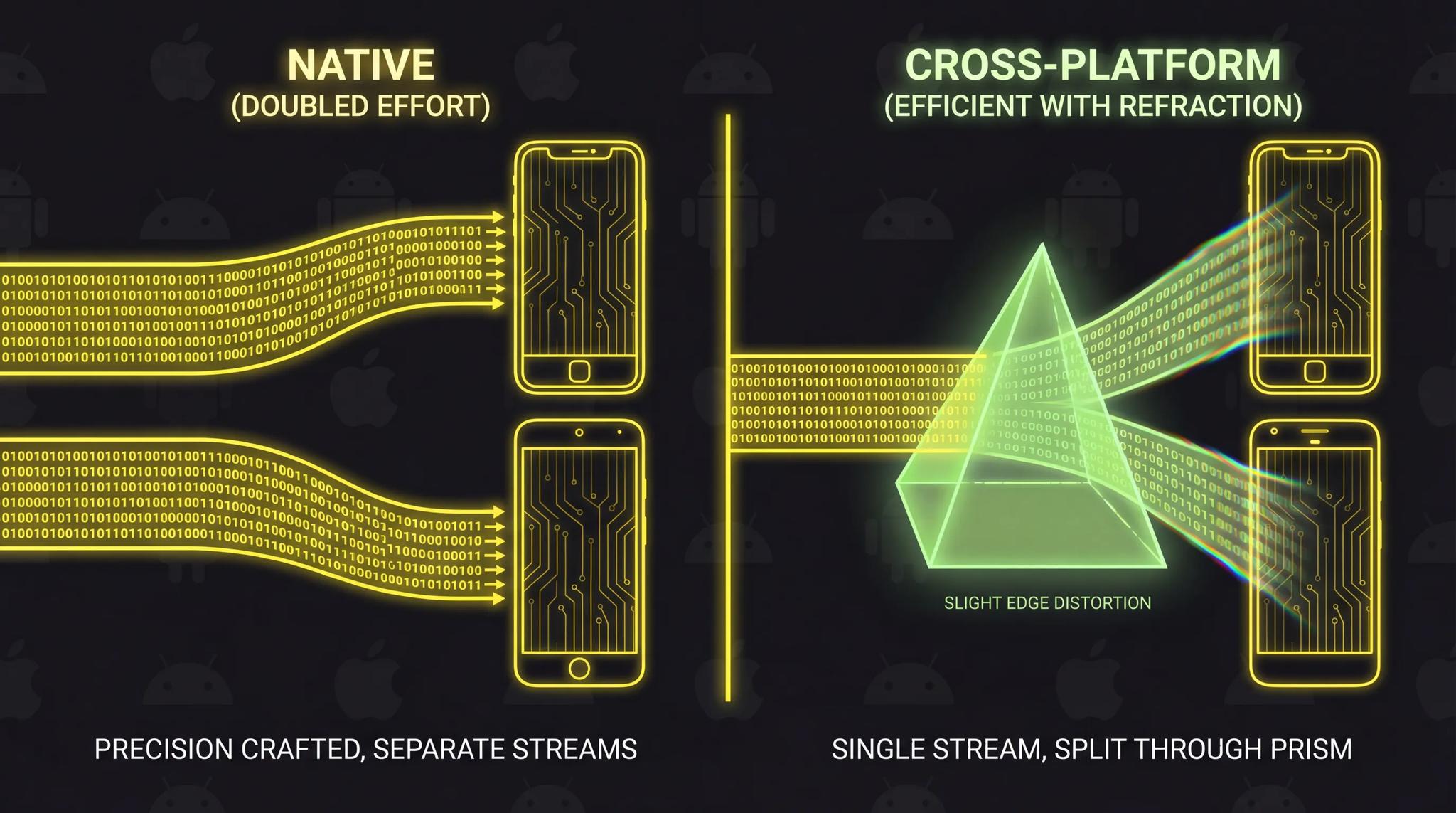
- Native apps are developed separately for each platform (iOS with Swift, Android with Kotlin), maximum performance, but double the cost and double the effort
- Cross-platform apps use a single codebase for multiple platforms, saving 30-40% in costs with nearly the same quality
- For 95% of all projects, cross-platform is the better approach
- Native development only pays off for very specific requirements like hardware-intensive games or AR applications
- Frameworks like Flutter have nearly closed the performance gap with native apps entirely
What Is a Native App?
A native app (native application) is built specifically for a single platform. For iOS, you write in Swift or SwiftUI; for Android, in Kotlin. The code runs directly on the operating system, with no abstraction layer in between.
What does "native" actually mean? The app uses the programming language recommended by the platform vendor itself. It has direct access to all hardware features: camera, GPS, Bluetooth, sensors, biometrics. Everything without detours.
Most pre-installed apps on your phone are native. The Settings app, the Camera app, the Calculator, all built specifically for the platform.
Typical native apps:
- Apple Health (Swift)
- Google Messages (Kotlin)
- Most pre-installed system apps
The advantage: Maximum performance and full platform access. The downside: You need a separate codebase for iOS and Android, a separate team (or at least a developer who masters both), and double the maintenance.
What Are Cross-Platform Apps?
A cross-platform app (cross-platform application) is developed with a single codebase for multiple platforms simultaneously. You write the code once and it runs on iOS, Android, and depending on the framework, also on web, desktop, and more.
The most well-known frameworks for this:
- Flutter (Dart), by Google, with its own rendering engine
- React Native (JavaScript/TypeScript), by Meta
- Kotlin Multiplatform (Kotlin), by JetBrains
Cross-platform doesn't mean "cheap" or "inferior". Major companies rely on it: How Flutter and Kotlin Multiplatform hold up in practice, even beyond the phone, is in Flutter on embedded hardware and Kotlin Multiplatform.
Well-known cross-platform apps:
- Google Earth (Flutter)
- Google Ads (Flutter)
- BMW App (Flutter)
- Instagram (React Native)
- Discord (React Native)
- Microsoft Teams (React Native)
These aren't hobby projects. These are apps with millions of users that need to work reliably every day.
The Direct Comparison
Here are the most important differences at a glance:
| Criterion | Native App | Cross-Platform App |
|---|---|---|
| Performance | Maximum, direct hardware access | Very good, minimal overhead |
| Development costs | High (2x codebase) | 30-40% cheaper |
| Time-to-market | Slower (2x development) | Significantly faster |
| UI/UX | Platform-perfect | Consistent or platform-close |
| Hardware access | Complete, direct | Nearly complete via plugins |
| Maintenance | 2x updates, 2x bugfixes | Fix once, solved everywhere |
| Code sharing | 0% | 90-95% |
| Talent pool | Large (Swift/Kotlin separately) | Growing (one developer, both platforms) |
My assessment: The table makes it clear, cross-platform wins in most categories. Native has advantages in raw performance and platform depth. But for most apps, that's not a decisive factor.
Advantages of Native Apps
Native has its place. Here are the real strengths:
Best performance: No intermediate layer, no framework overhead. For compute-intensive apps (3D games, real-time video processing), this matters.
Full platform access: Every new iOS or Android feature is immediately available. With cross-platform, you sometimes have to wait for plugin updates, although with Flutter, that usually only takes days.
Platform-native UX: The app feels exactly the way users expect from their respective platform. Every animation, every gesture, every transition follows the platform guidelines.
App Store optimization: There's a theory that Apple favors native Swift apps in the App Store. There's no hard evidence for this, but it's an argument that keeps coming up.
Disadvantages of Native Apps
And here's where it gets painful:
Double development costs: You pay for every feature twice. A login for iOS, a login for Android. A chat for iOS, a chat for Android. With typical app costs of 15,000-40,000 EUR, we're quickly talking about 1.5 to 2 times that amount.
Double maintenance: Every bugfix, every update, every adjustment, twice. And the bugs are often different because there are two separate codebases.
Two teams or one very versatile developer: Swift and Kotlin developers are rarely the same person. You either need two specialists or a generalist who's good in both worlds but excellent in neither.
Slower time-to-market: Developing two apps in parallel takes longer. In a market where speed matters, that can be a real disadvantage.
Advantages of Cross-Platform Apps
Now for the other side, and my clear recommendation for most projects:
One codebase, all platforms: You write the code once. It runs on iOS and Android. With Flutter, even on web, macOS, Windows, and Linux. This isn't just cost-efficient, it also eliminates those "but on Android it works differently" problems.
30-40% cost savings: If you want to have an app developed, that's a massive difference. Instead of 60,000 EUR for two native apps, you pay 35,000-40,000 EUR for a cross-platform app that runs on both platforms.
Faster time-to-market: Build a feature, test it, deploy it, done. For both platforms at the same time. In my projects, this typically saves 4-8 weeks of development time.
Consistent user experience: Your app looks the same on iOS and Android and behaves the same way. This is especially important for brands that want a unified appearance.
Easier maintenance: A bug? Fix it once. An update? Deploy it once. This saves not only money but also headaches. Especially when it comes to ongoing costs, this makes a noticeable difference in the long run.
Disadvantages of Cross-Platform Apps
Cross-platform isn't perfect. Here are the honest downsides:
Slight performance gap: Yes, there's a measurable difference. But it keeps getting smaller. Flutter renders with its own engine directly to the GPU, 60fps or 120fps is standard. For 99% of apps, that's more than enough.
Platform-specific features require extra work: Want to use a feature that only exists on iOS? Then you need Platform Channels or a plugin. It works, but it's a bit more effort than in a native app.
Framework dependency: You depend on Google (Flutter), Meta (React Native), or JetBrains (KMP) to continue developing the framework. With Flutter, I see no risk there, Google uses it for business-critical products themselves. But it's a factor you should be aware of.
Recruiting: There are fewer Flutter developers than Swift or Kotlin developers. However: one Flutter developer replaces two native developers. At the end of the day, you need fewer people.
When Native, When Cross-Platform?
Here's my decision matrix from real-world experience:
Choose native if:
- You're building a hardware-intensive 3D game (Unity/Unreal is the better choice here anyway)
- Your app relies heavily on ARKit or ARCore and every percent of performance counts
- You're only developing for a single platform and that's going to stay that way
- You have a large team of specialized iOS and Android developers who need to stay busy
Choose cross-platform if:
- You want to launch on iOS and Android simultaneously
- Budget and time-to-market matter
- You have a small to mid-sized team
- Your app doesn't have extreme hardware requirements
- You might consider web or desktop later
- You want to build an MVP and iterate quickly
My take: The "native-only" arguments often come from a time when cross-platform really did mean compromises. In 2016, that was the case. In 2026, it isn't. The frameworks have evolved massively.
My Honest Recommendation
From my experience with Flutter:
Cross-platform is the better approach for 95% of all projects. And if cross-platform, then Flutter.
Why? Because Flutter offers the best of both worlds. You get native performance (its own rendering engine, no JavaScript bridge overhead), one codebase for all platforms, and an ecosystem that's growing fast.
I've used it to build digital learning platforms, B2B apps for enterprises, and MVPs that went live within a few weeks. In none of these projects would native development have brought a noticeable advantage, but the costs would have been significantly higher.
The few cases where I recommend native development:
- Games with demanding 3D graphics (Unity or Unreal is better than both here)
- AR applications that need every last bit of performance
- Apps deeply integrated into a single platform's ecosystem (e.g., a standalone Apple Watch app)
For everything else? Flutter. No question.
If you're interested in the comparison between cross-platform frameworks, check out my Flutter vs. React Native comparison for 2026. And why I personally bet on Flutter is something I explain in Why I love Flutter.
Thinking about building an app? Learn more about my Flutter app development services here.
Frequently Asked Questions
A native app (native application) is an application developed specifically for a particular operating system. For iOS, you use Swift or SwiftUI; for Android, Kotlin or Java. Native apps have direct access to all hardware features and deliver the best possible performance. The downside: you need a separate codebase for each platform.
Flutter is a cross-platform framework. You write the code once in Dart, and it runs on iOS, Android, web, and desktop. However, Flutter compiles to native ARM code, so the app doesn't run in a browser or a sandbox. That's why some people refer to it as "natively compiled cross-platform". The performance is comparable to native apps.
They used to be, but barely anymore today. Modern frameworks like Flutter render with their own engine directly to the GPU and consistently achieve 60 or 120 FPS. For the vast majority of apps, shopping, social, productivity, B2B, you won't notice a difference. Only with hardware-intensive 3D applications or intensive AR does native still have a measurable advantage.
Native development for iOS and Android typically costs 1.5 to 2 times as much as a cross-platform app because you need two separate codebases. A standard cross-platform app costs between 15,000 and 40,000 EUR, while native for both platforms runs more like 25,000 to 70,000 EUR. You can find more details in my cost guide for 2026.
In my experience, Flutter, and by a clear margin. Its own rendering engine ensures consistent performance, the widget system is well-designed, and you can use it to cover not only mobile but also web and desktop. React Native is a solid alternative, especially if your team already knows JavaScript/React. You can find a detailed comparison in my Flutter vs. React Native article.
Technically yes, but in practice you almost never need to. If your app is built with Flutter and you later need a feature that requires deep native access, you can integrate native Swift or Kotlin code via Platform Channels, without rewriting the entire app. A complete switch to native is possible but essentially means rebuilding from scratch.