
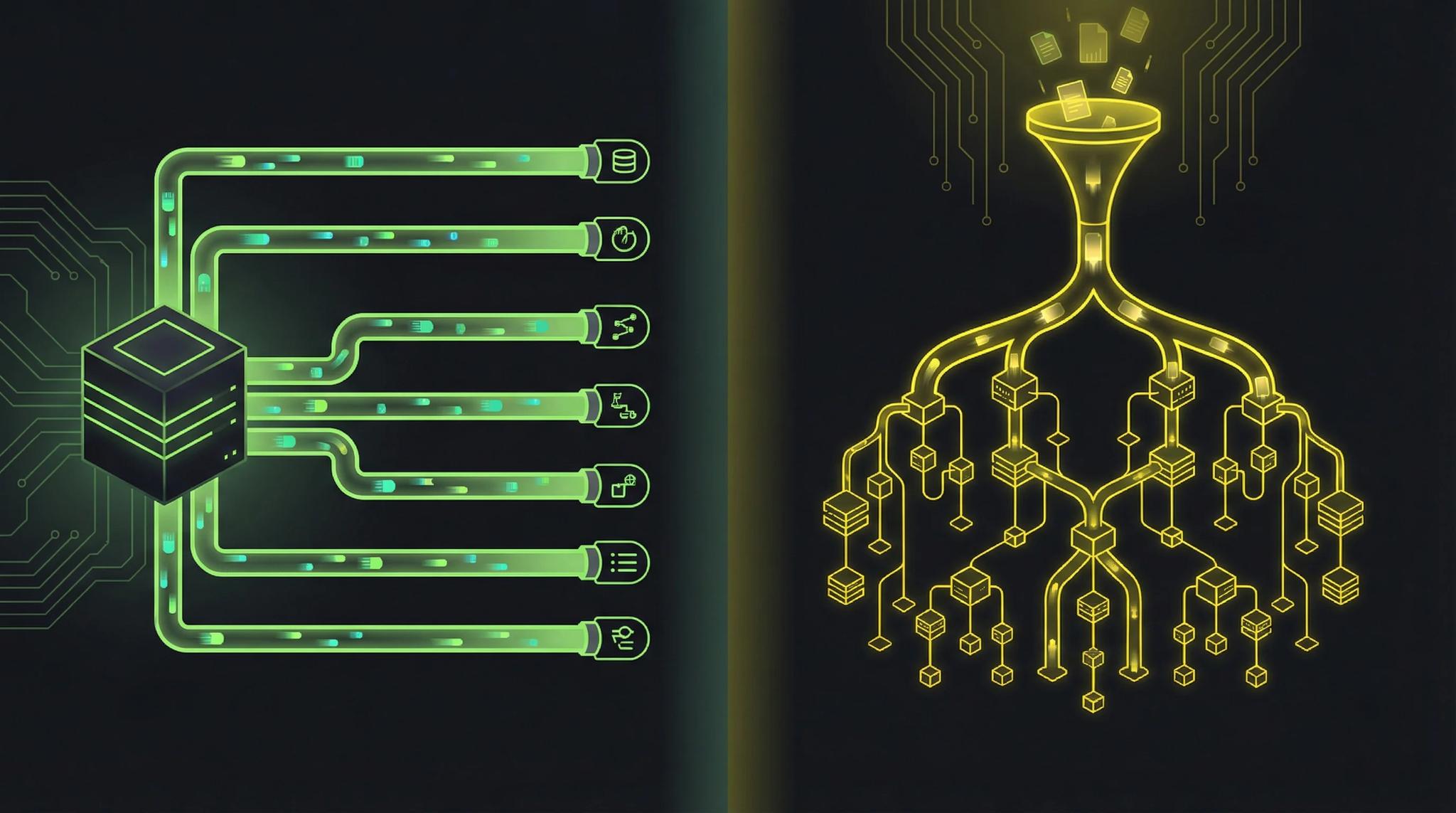

REST or GraphQL? If you're planning an app or backend right now, that's one of the first questions that comes up. Both approaches have their place -- and both can be the wrong choice if you use them in the wrong context. Let me show you when you need what.
Quick Summary
Before we get into the details, here's a quick overview of both approaches:
| Criteria | REST | GraphQL |
|---|---|---|
| Architecture | Resource-oriented, multiple endpoints | Single endpoint, query-based |
| Data fetching | Server determines the structure | Client determines the structure |
| Learning curve | Low | Medium to high |
| Caching | Simple (HTTP caching) | Complex (client-side) |
| Over-fetching | Common issue | Not a problem |
| Tooling | Available everywhere | Growing ecosystem |
| Real-time | Polling or WebSockets separately | Subscriptions built-in |
If you're not quite sure what an API even is: Check out my article What is an API? first.
What is REST?
REST stands for Representational State Transfer and has been the standard for web APIs for over 20 years. The principle is simple: Every resource has its own URL, and you use HTTP methods like GET, POST, PUT, and DELETE to interact with it.
A REST interface example: You want to fetch user data. You send a GET request to a specific endpoint:
GET /api/users/123
The server responds with a JSON object containing all data for that user. Want all blog posts? Different endpoint:
GET /api/posts
Want to create a new post? Same endpoint, different method:
POST /api/posts
The beauty of REST: It uses standards every web developer knows. HTTP methods, status codes, URLs -- none of this is new. The learning curve is gentle, the documentation is massive, and virtually every programming language has REST support built in.
REST is what most APIs on the internet use. When you build a REST API, you're building on a proven foundation.
What is GraphQL?
GraphQL was released in 2015 by Meta (then Facebook) and takes a completely different approach. Instead of many endpoints, there's only one: /graphql. The client sends a query and describes exactly which data it needs.
An example:
query {
  user(id: "123") {
    name
    email
    posts {
      title
      createdAt
    }
  }
}
The result? You get back exactly what you asked for. Nothing more, nothing less. No over-fetching, no unnecessary data.
That's the big difference: With REST, the server determines what data is included in a response. With GraphQL, the client decides. Sounds like a small detail, but it changes the entire architecture of your application.
GraphQL also has a built-in type system. You define a schema, and both client and server know exactly which data exists in which format. This makes development type-safe and documentation practically generates itself.
SOAP Briefly Explained
Before we get to the direct REST vs GraphQL comparison, a quick detour: You might also stumble upon SOAP, especially when searching for SOAP vs REST vs GraphQL.
SOAP (Simple Object Access Protocol) is the predecessor to REST and uses XML instead of JSON. It's extremely structured, has built-in error handling, and is primarily used today in legacy systems, banks, and insurance companies.
My honest opinion: For new projects in 2026, SOAP is the wrong choice in the vast majority of cases. Too verbose, too complex, too unfriendly for developers. Unless you're forced to connect to a SOAP interface (because your client has a legacy system), stick with REST or GraphQL.
In short: SOAP is the dinosaur, REST is the reigning champion, GraphQL is the challenger.
REST vs GraphQL: The Direct Comparison
Now let's get specific. Here are both API architectures compared in detail:
Performance
REST: Individual endpoints deliver fixed data structures. For a complex view, you often need multiple requests (e.g., first load the user, then their posts, then the comments). That's called under-fetching.
GraphQL: A single request can deliver nested data. User, posts, and comments all in one go. Fewer network round-trips, but server-side processing can be more complex.
Verdict: GraphQL wins for complex, nested data. REST is more efficient for simple CRUD operations.
Flexibility
REST: The API structure is dictated by the server. If the frontend needs different data than what the backend delivers, you either need to build a new endpoint or modify the existing one.
GraphQL: The client determines the data structure. Different frontends (web, mobile, smart TV) can send different queries to the same API.
Verdict: GraphQL is significantly more flexible, especially with multiple clients.
Learning Curve
REST: If you understand HTTP, you understand REST. GET, POST, PUT, DELETE -- done. The concepts are intuitive and there are countless tutorials.
GraphQL: New paradigm, new syntax, new type system. Queries, mutations, subscriptions, resolvers, schema definition language -- there's quite a bit to take in.
Verdict: REST is significantly easier to learn.
Caching
REST: Because every resource has its own URL, HTTP caching works out of the box. Browsers, CDNs, reverse proxies -- they can all cache REST responses.
GraphQL: All requests go to the same endpoint via POST. Standard HTTP caching doesn't work. You need client-side solutions like Apollo Client or urql.
Verdict: Caching is much simpler with REST.
Real-Time Data
REST: No built-in mechanism. You need to implement WebSockets, Server-Sent Events, or polling separately.
GraphQL: Subscriptions are part of the specification. You can subscribe to real-time updates directly through your GraphQL API.
Verdict: GraphQL has the edge here -- at least from an architecture perspective.
Tooling
REST: Postman, Swagger/OpenAPI, curl -- the tools are established and available everywhere. Every IDE has REST support.
GraphQL: GraphiQL, Apollo DevTools, Playground -- the tooling is good but smaller. The built-in schema explorer, however, is a real highlight.
Verdict: REST has more tools, GraphQL has better introspection.
Over-Fetching and Under-Fetching
REST: A classic REST interface example: You query the /users/123 endpoint and get back 30 fields, even though you only need name and email. That's over-fetching. Or you also need the user's posts and have to make a second request -- under-fetching.
GraphQL: Doesn't exist. You query exactly what you need.
Verdict: GraphQL solves the over-fetching/under-fetching problem elegantly.
REST API Example
Here's a concrete RESTful interface example. You want to fetch a user with their latest blog posts:
Request 1 -- User data:
curl -X GET https://api.example.com/users/123 \
  -H "Authorization: Bearer your-token"
Response:
{
  "id": 123,
  "name": "Max Mustermann",
  "email": "max@example.com",
  "avatar": "https://api.example.com/avatars/123.webp",
  "role": "admin",
  "createdAt": "2024-03-15T10:30:00Z",
  "lastLogin": "2026-02-11T18:45:00Z",
  "settings": {
    "theme": "dark",
    "language": "en",
    "notifications": true
  }
}
Request 2 -- User's posts:
curl -X GET https://api.example.com/users/123/posts?limit=3 \
  -H "Authorization: Bearer your-token"
Response:
{
  "data": [
    {
      "id": 456,
      "title": "My First Post",
      "excerpt": "A quick look at...",
      "createdAt": "2026-02-10T14:00:00Z"
    },
    {
      "id": 457,
      "title": "Understanding REST APIs",
      "excerpt": "An introduction to...",
      "createdAt": "2026-02-11T09:00:00Z"
    }
  ],
  "meta": {
    "total": 24,
    "page": 1,
    "limit": 3
  }
}
Two requests, and with Request 1 you also get fields like settings, avatar, and lastLogin that you might not even need. Classic over-fetching.
GraphQL Example
The same query with GraphQL -- a single request:
Query:
query GetUserWithPosts {
  user(id: "123") {
    name
    email
    posts(limit: 3) {
      title
      excerpt
      createdAt
    }
  }
}
Response:
{
  "data": {
    "user": {
      "name": "Max Mustermann",
      "email": "max@example.com",
      "posts": [
        {
          "title": "My First Post",
          "excerpt": "A quick look at...",
          "createdAt": "2026-02-10T14:00:00Z"
        },
        {
          "title": "Understanding REST APIs",
          "excerpt": "An introduction to...",
          "createdAt": "2026-02-11T09:00:00Z"
        }
      ]
    }
  }
}
One request, exactly the data you need. No over-fetching, no under-fetching. That's the charm of GraphQL.
When REST, When GraphQL?
After many projects with both approaches, here's my decision guide:
Choose REST when:
- You're building a simple CRUD backend
- Your team has little API experience
- You need strong HTTP caching (e.g., for public APIs)
- You have a microservice architecture with clear resources
- You want to get started quickly without much setup
- You're offering a public API for third parties
Choose GraphQL when:
- Multiple clients (web, iOS, Android) need different data
- Your data structures are heavily nested
- Over-fetching is a real performance issue (e.g., mobile apps on slow networks)
- You're building a complex dashboard or data-intensive app
- Your frontend team should work independently from the backend
- You need real-time features via subscriptions
And sometimes the answer is: Both. There's nothing wrong with using REST for simple CRUD endpoints and GraphQL for complex data queries. Many large projects run this hybrid strategy.
My Recommendation for App Projects
I mainly build apps with Flutter and work with various backend architectures. Here's my honest assessment for 2026:
For most projects: REST. For one simple reason -- simplicity. REST is battle-tested, every developer understands it, and the tooling is everywhere. If you're building a backend for your app, REST is the right choice in 90% of cases.
When I reach for GraphQL: When I have a project where different clients (web dashboard, mobile app, admin panel) access the same data but each need different views. That's where GraphQL shines.
What I don't recommend: Choosing GraphQL just because it sounds "modern." The additional complexity needs to be justified by a concrete advantage. If your REST backend is well-structured and your client is exactly one app, you don't need GraphQL.
And don't forget: The API architecture is just one piece of the puzzle. Just as important is how your frontend communicates with the backend and how your backend is structured overall.
Frequently Asked Questions
Not automatically. GraphQL can require fewer network round-trips because you query nested data in a single request. But the server-side processing of a complex GraphQL query can be more demanding than a simple REST call. GraphQL vs REST performance depends heavily on the use case.
Yes, and you don't have to switch everything at once. Many teams deploy GraphQL as a gateway in front of their existing REST APIs. This way you can migrate gradually without completely rebuilding the backend.
You need a GraphQL server library (e.g., Apollo Server, GraphQL Yoga, Mercurius), but these run on any common server framework. Node.js, Python, Go, Dart -- there are implementations for virtually every language.
GraphQL has advantages for mobile apps because you fetch exactly the data you need. Less data = less bandwidth = faster loading times. But if your REST API is well-designed and you need few endpoints, the difference is minimal.
No. REST is still the standard and will remain so in 2026. GraphQL is an alternative for specific use cases, not a replacement. Both technologies will coexist -- similar to SQL and NoSQL databases.